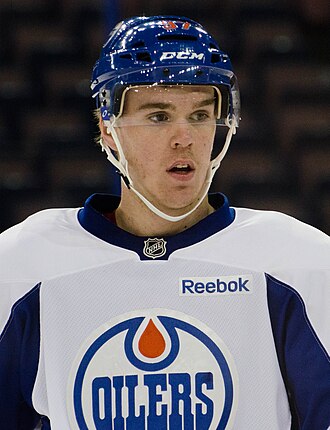
Photo by Connor Mah, CC BY-SA 3.0

Connor McDavid
Edmonton Oilers Center #97
The fastest player in the league is also its most patient one; the danger is not the speed itself but what he does at the end of it.
| Season | Team | GP | G | A | PTS | +/- | PIM | PP | SH | GW | S | S% | TOI |
|---|---|---|---|---|---|---|---|---|---|---|---|---|---|
| 2015-16 | EDM | 45 | 16 | 32 | 48 | -1 | 18 | 3 | 0 | 5 | 105 | 15.2 | 18:53 |
| 2016-17 | EDM | 82 | 30 | 70 | 100 | +27 | 26 | 3 | 1 | 6 | 251 | 11.9 | 21:08 |
| 2017-18 | EDM | 82 | 41 | 67 | 108 | +20 | 26 | 5 | 1 | 7 | 274 | 15.0 | 21:33 |
| 2018-19 | EDM | 78 | 41 | 75 | 116 | +3 | 20 | 9 | 1 | 9 | 240 | 17.1 | 22:50 |
| 2019-20 | EDM | 64 | 34 | 63 | 97 | -6 | 28 | 11 | 0 | 6 | 212 | 16.0 | 21:52 |
| 2020-21 | EDM | 56 | 33 | 72 | 105 | +21 | 20 | 9 | 0 | 11 | 200 | 16.5 | 22:09 |
| 2021-22 | EDM | 80 | 44 | 79 | 123 | +28 | 45 | 10 | 0 | 9 | 314 | 14.0 | 22:04 |
| 2022-23 | EDM | 82 | 64 | 89 | 153 | +22 | 36 | 21 | 4 | 11 | 352 | 18.2 | 22:23 |
| 2023-24 | EDM | 76 | 32 | 100 | 132 | +35 | 30 | 7 | 1 | 5 | 263 | 12.2 | 21:22 |
| 2024-25 | EDM | 67 | 26 | 74 | 100 | +20 | 37 | 9 | 0 | 3 | 196 | 13.3 | 22:02 |
| 2025-26 | EDM | 82 | 48 | 90 | 138 | +17 | 44 | 13 | 1 | 4 | 306 | 15.7 | 22:59 |
| 2026-27 so far | — | — | — | — | — | — | — | — | — | — | — | — | — |
| Career | — | 794 | 409 | 811 | 1220 | +186 | 330 | 100 | 9 | 76 | 2713 | 15.1 | 21:52 |
This Season So Far
The 2026-27 season has not started. The empty row above is his, and both it and this paragraph fill in on their own from the morning after he first plays: what he has done, what it is worth against his own last season, and the run he is on when the two disagree.
Last Season
48 goals and 90 assists in a full 82 games, on 306 shots and nearly 23 minutes a night. The raw totals undersell what the games look like: Edmonton’s offense is organized around one player’s ability to enter the zone with control, and the club’s expected-goals share collapses whenever he sits.
The Finesse Game
The skating is the first thing and the last thing. He gets to top speed inside 2 strides, which is what forces defensemen to turn early, and once they have turned he has beaten them - the crossover cut back into the middle is the play he has built a career on. Nobody in the league changes direction at that speed with the puck still in a shooting position.
What separates him from other fast players is that he does not treat speed as the finish. He slows the play down at the moment everyone else expects it to accelerate, drifting below the goal line or curling off the wall until a seam opens, and he is comfortable holding the puck longer than any coach would draw up because he can see the second and third options before they exist. The backhand pass into the slot is genuinely elite.
The shot is a good shot on a great passer, which is the only sense in which it is underrated. He shoots 15 percent because he takes very few bad ones - he will pass up a contested wrist shot from distance to work one more play out of the possession.
The Physical Game
He is 6-1 and 194 pounds and he plays every bit of it, but he is not a hitter and never has been. What he does have is unusual balance through contact: defensemen who get a piece of him along the wall rarely knock him off the puck, and he protects it by turning his back and using his feet rather than his frame.
The one place teams still try him is on the forecheck, hammering him a half-second after a pass. It has not worked in years. He is far better at taking a hit to make a play than most stars are willing to be, and he plays a full season of them.
The Intangibles
The competitiveness is not the marketing version. He is visibly furious about losing games and shifts, and it occasionally costs him - he will try to win a game by himself in the third period of a tight one when the simple play was on. That is the honest criticism of him and it is a small one.
The rest is a captain who has kept a team pointed in one direction for a decade. Younger players in that room learn how to practice by watching him, which is the kind of thing that never turns up in a stat line and matters more than most of what does.
What kind of player
The searchable half of the report. The first group is computed from the season's own data; the rest are read out of the prose above, and each one carries the sentence that produced it. A subject the report never raised is simply absent.
- measuredcomputed here from the season's own data
Each computed tag also says how well its measure holds up from one season to the next, because a tag describes a season that has finished and a reader will assume it predicts the one coming. Some do and some do not, and the gap is wide: five-on-five workload repeats well, scoring late does not repeat at all.
- durable· was available
82 of 82 games
Season to season, this measure repeats weakly (0.32) · 53% keep it
- drives-play· the shot clock turns his way while he is out there
57.3% of the expected goals at five-on-five with him on, 47.7% for his club in the minutes he sat: +9.6, 100th percentile among forwards
Season to season, this measure repeats moderately (0.39) · 29% keep it
- workhorse· carries the load at even strength
17:10 a game at five-on-five, 100th percentile among forwards
Season to season, this measure repeats well (0.78) · 58% keep it
- sheltered· is started in the attacking end
64% of his end-zone starts in the attacking end, 94th percentile among forwards
Season to season, this measure repeats well (0.66) · 47% keep it
The numbers underneath
On the ice
Five-on-five, 2025-26 · 1,408 minutes
- Expected goals
- 57.3%
- 96th pct
- Shot attempts
- 54.2%
- 87th pct
share of the chances while he was out there
share of the attempts while he was out there
Goals while he was on the ice: 75 for, 68 against. Expected: 81.6 and 60.9.
The eye and the numbers
SightedThe two rank him within 4 points of one another. It was written with these numbers on screen, so the agreement is not corroboration — the arithmetic is on both sides of it.
Both bars are percentiles among the 656 skaters in this edition with a report and enough ice time. The report bar ranks the mean of the grades above — 89 on their own scale — against every other report's mean. The numbers bar ranks his share of expected goals. A gap is a disagreement about where he belongs, not two scales talking past each other.
Tracked
NHL Edge, 2025-26 · 82 games
- Top speed
- 24.6 mph
- 100th pct
- Bursts over 20 mph
- 8.30 a game
- Distance
- 4.03 miles a game
- Hardest shot
- 82.0 mph
- 31st pct
fastest he was clocked all season; the league's average best is 22.2
how often he reaches that speed, not how fast he goes
skated, all strengths
one shot; the league's average best is 83.6
A top speed is a season's best, and a man who takes more shifts gets more tries at one; the percentile is the feed's own, against every skater, and says less between a top-pair defenceman and a fourth-line wing than it does between two men in the same job. The counts are shown per game for the same reason.
Recent form
Last 20 appearances, 2025-26, oldest first
21
points in his last 10 games — 9 goals, 12 assists, 46 shots
Each bar is one game by points. Filled bars are games he scored in.
Usual linemates
2025-26 · 1408 minutes at five-on-five
- Zach Hyman52%
- Matt Savoie24%
Share of his five-on-five ice time spent alongside each player, measured from shift charts. Special teams are excluded: a power-play unit is not a line.
Why the numbers land there
Five-on-five, 2025-26
- The club
- EDM took 51.6% of the expected goals as a club. His own share is 57.3% — 5.7 above the club he did it on.
- The role
- First line, 1,408 minutes at five-on-five — 93rd percentile in ice time.
With and without
| Teammate | Together | Him apart | Mate apart |
|---|---|---|---|
| Evan Bouchard | 61.2% | 49.8% | 52.3% |
| Mattias Ekholm | 60.9% | 51.7% | 54.0% |
| Zach Hyman | 59.1% | 55.0% | 41.0% |
61.2% together, 49.8% for him apart and 52.3% for Bouchard apart. Both were worse apart, so whatever the two of them had together was doing real work.
Expected-goal share while both were on the ice, and for each man in the minutes he played without the other. Apart is the pair subtracted from his own totals. It does not settle who was carrying whom — apart from each other, both were still playing with somebody — but it does say whether the share travelled when the pairing broke up.
Where he shoots from
goal on goal missed
423 unblocked shots in 2025-26, 47 of them goals. His median goal came from 16 feet. 48% of his shots came from inside twenty feet.