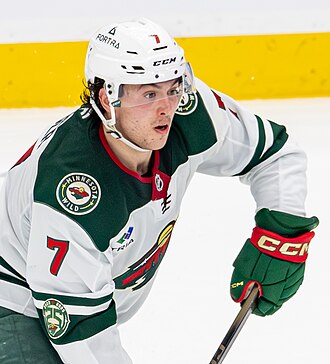
Photo by Jenn G from Seattle, WA, CC BY-SA 4.0

Brock Faber
Minnesota Wild Defense #7
23 years old and already playing 25 minutes a night against the other team's best.
| Season | Team | GP | G | A | PTS | +/- | PIM | PP | SH | GW | S | S% | TOI |
|---|---|---|---|---|---|---|---|---|---|---|---|---|---|
| 2022-23 | MIN | 2 | 0 | 0 | 0 | +2 | 0 | 0 | 0 | 0 | 1 | 0.0 | 20:04 |
| 2023-24 | MIN | 82 | 8 | 39 | 47 | -1 | 26 | 3 | 0 | 1 | 136 | 5.9 | 24:58 |
| 2024-25 | MIN | 78 | 10 | 19 | 29 | -2 | 23 | 2 | 0 | 1 | 124 | 8.1 | 25:32 |
| 2025-26 | MIN | 80 | 15 | 36 | 51 | +18 | 39 | 1 | 1 | 1 | 173 | 8.7 | 24:41 |
| 2026-27 so far | — | — | — | — | — | — | — | — | — | — | — | — | — |
| Career | — | 242 | 33 | 94 | 127 | +17 | 88 | 6 | 1 | 3 | 434 | 7.6 | 25:01 |
This Season So Far
The 2026-27 season has not started. The empty row above is his, and both it and this paragraph fill in on their own from the morning after he first plays: what he has done, what it is worth against his own last season, and the run he is on when the two disagree.
Last Season
15 goals and 51 points in 80 games, plus-18, on 24:41 a night and 1,628 5-on-5 minutes — the most on the team by a distance. 15 goals from a defenceman who is not the power-play quarterback is a striking number.
The Finesse Game
He skates well enough to defend the rush against anybody and to join it without getting caught, which is the foundation of the whole workload. The first pass is quick and accurate, and he has become comfortable carrying the puck out himself when the forecheck takes the outlet away.
The shot is heavier than expected and he gets it through — a good deal of his offence is simply arriving at the right moment from the point and putting a puck on net through a screen.
He plays 50 percent of his 5-on-5 minutes alongside Hughes, and the 2 of them are the reason this defence functions. Watching which of them drives that pairing is one of the better arguments available about this team.
The Physical Game
6-1 and 200, and he defends physically without being punishing. He is strong on the wall, willing in front of his own net, and takes the body when it ends a play rather than when it looks good.
The concern is mileage rather than durability. He has played enormous minutes since the day he arrived, at an age when most defencemen are being protected.
The Intangibles
Acquired as a prospect in a trade for a franchise winger, which is the kind of deal that follows a player around. It has aged extremely well.
He is not a flashy player and he will not win awards while playing beside somebody who does. He is, on the evidence so far, going to be a number-1 defenceman for a decade.
What kind of player
The searchable half of the report. The first group is computed from the season's own data; the rest are read out of the prose above, and each one carries the sentence that produced it. A subject the report never raised is simply absent.
- measuredcomputed here from the season's own data
Each computed tag also says how well its measure holds up from one season to the next, because a tag describes a season that has finished and a reader will assume it predicts the one coming. Some do and some do not, and the gap is wide: five-on-five workload repeats well, scoring late does not repeat at all.
The numbers underneath
On the ice
Five-on-five, 2025-26 · 1,628 minutes
- Expected goals
- 52.2%
- 72nd pct
- Shot attempts
- 50.2%
- 60th pct
share of the chances while he was out there
share of the attempts while he was out there
Goals while he was on the ice: 80 for, 75 against. Expected: 75.1 and 68.7.
The eye and the numbers
SightedThe report ranks him 23 points above where the numbers do. It was written with these numbers on screen and departs from them anyway, which makes the gap a judgment rather than an oversight. Why the numbers land there sets out the club he did it on, the minutes he played and the men he played them with.
Both bars are percentiles among the 656 skaters in this edition with a report and enough ice time. The report bar ranks the mean of the grades above — 82 on their own scale — against every other report's mean. The numbers bar ranks his share of expected goals. A gap is a disagreement about where he belongs, not two scales talking past each other.
Tracked
NHL Edge, 2025-26 · 80 games
- Top speed
- 23.0 mph
- 93rd pct
- Bursts over 20 mph
- 1.61 a game
- Distance
- 3.54 miles a game
- Hardest shot
- 92.7 mph
- 63rd pct
fastest he was clocked all season; the league's average best is 21.6
how often he reaches that speed, not how fast he goes
skated, all strengths
one shot; the league's average best is 88.9
A top speed is a season's best, and a man who takes more shifts gets more tries at one; the percentile is the feed's own, against every skater, and says less between a top-pair defenceman and a fourth-line wing than it does between two men in the same job. The counts are shown per game for the same reason.
Recent form
Last 20 appearances, 2025-26, oldest first
4
points in his last 10 games — 1 goals, 3 assists, 22 shots
Each bar is one game by points. Filled bars are games he scored in.
Usual linemates
2025-26 · 1628 minutes at five-on-five
- Quinn Hughes50%
- Jonas Brodin34%
Share of his five-on-five ice time spent alongside each player, measured from shift charts. Special teams are excluded: a power-play unit is not a line.
Why the numbers land there
Five-on-five, 2025-26
- The club
- MIN took 50.5% of the expected goals as a club. His own share is 52.2% — 1.7 above the club he did it on.
- The role
- First pair, 1,628 minutes at five-on-five — 100th percentile in ice time.
With and without
| Teammate | Together | Him apart | Mate apart |
|---|---|---|---|
| Quinn Hughes | 55.7% | 48.3% | 50.3% |
| Kirill Kaprizov | 52.3% | 52.2% | 54.7% |
| Jonas Brodin | 48.8% | 53.8% | 54.5% |
55.7% together, 48.3% for him apart and 50.3% for Hughes apart. Both were worse apart, so whatever the two of them had together was doing real work.
Expected-goal share while both were on the ice, and for each man in the minutes he played without the other. Apart is the pair subtracted from his own totals. It does not settle who was carrying whom — apart from each other, both were still playing with somebody — but it does say whether the share travelled when the pairing broke up.
Where he shoots from
goal on goal missed
254 unblocked shots in 2025-26, 15 of them goals. His median goal came from 34 feet. 7% of his shots came from inside twenty feet, 70% from beyond forty.